

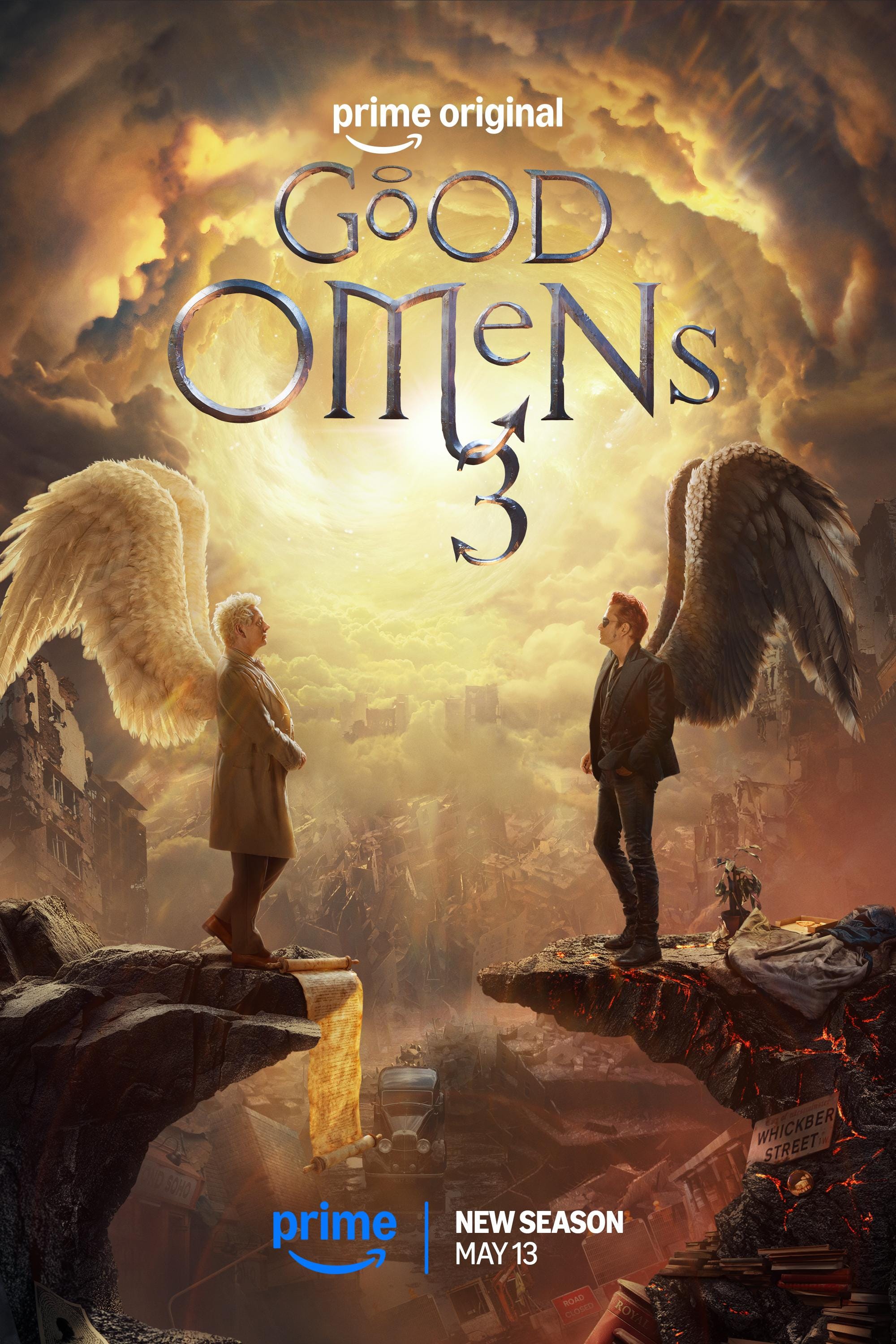
So, I’ll just say this up front: I’m not reviewing this for the same reason I did Sandman; I’ve nothing more to say on one of the two authors of the novel that inspired this series, who also was at some point its chief architect. I am instead writing about it for the sake of the women and men who made it that aren’t him—predominantly David Tennant and Michael Sheen, the former of whom is a favorite actor of mine—and to mark the end of a multi-year media saga in my own life, and because, ultimately, I thought Good Omens had something interesting to say, even if it didn’t have the theological finesse to say it as well as it might have otherwise.
I’m also going to more or less skip the Jesus of it all. The Jesus plotline will likely strike the ordinary viewer as blasphemous, which is probably partly the point, and it also contributes almost nothing to the story, which I suspect, were the author not who he is with the consequences thereof for his products, might have had more room for it. Or, I suppose, I’ll ignore it beyond saying: if one believes in an intrahistorical descent of Jesus from heaven to judge the living and the dead and reign in perpetuity, ad litteram, as the Creed says, then one ought to labor to ensure that one’s picture of what that’s going to look like is not silly enough to be easily mocked by something like Good Omens. Or, one should grapple with the real difficulty in imagining in the twenty-first century what it would mean for Jesus of Nazareth, flesh and blood, to return to Earth, whether with the archangel’s shout or with a multiplying pizza. (Perhaps I’m overdue for revisiting the Second Coming in another article.)
The real, fundamental question at the heart of Good Omens, which Crowley gets to pitch directly to God at the end, is this: given the strict standards of right and wrong that God proposes—and reifies through the creation and sustenance of the Satan character—why make people in such a way that they don’t have a legitimate chance to get it right, ensconced as they are in the vicissitudes of existence? Heaven and Hell both are ideological absolutists in a universe designed, allegedly, around ideological absolutes but, in reality, easily given to chaos through the ignorance, incompetence, and malice of even its highest and oldest beings. If what God wanted was perfect people, why not make them with perfect chances?
This is a very dharmic question, and it’s not a new idea in Good Omens. Crowley’s schtick all along, from Season One’s narrow circumvention of the Antichrist through Season Two’s misadventures with Gabriel, has been that the powers that be, “Upstairs” and “Downstairs,” don’t actually know what God wants. That’s the kicker: the angels and demons both are functionally gods, but they are as unaware of what God really cares about as the devas are of brahman. Left to their own devices, they make it up as they go along. God’s real plan, Crowley surmises, may have all along been that the friendship—and love—between himself and Aziraphale (Sheen) was the actual divine providence, predicated on keeping the universe going and, now, in the birth of a new one.
God, bemused by their request, agrees to leave a decision up to Crowley and Aziraphale, who ask that God create a universe that is functionally godless and devoid of angels and demons. It will be a cosmos they themselves cannot inhabit, but it will be a universe that’s genuinely free. As it turns out, though, they inhabit it in a sense: their archetypes and those of the other angelic and demonic beings find a home in the new universe, in its Earth and with its people. The new, human Crowley doesn’t long to know if there’s more out there; he’s content with his human life and cosmic beauty.
Modern Britain is an Epicurean land, and most of its good art is Epicurean; that’s as may be. One doesn’t have to agree that the Epicurean universe is ultimately true to concede that the Epicurean lovestruck gratitude for the pleasures of mundanity is a spiritually informed view of life—somewhat despite the contours of Epicureanism. There’s a worthy provisional wisdom to the idea that the moderate pleasure of experience is a good unto itself; I think there’s more to life than that, and that all Epicureans I’ve known personally or read about are basically hiding from that fact, but I don’t have to ignore what they have right to call out what they have wrong.
This is also the way to understand, I think, what the series suggests about God but also what it could have said. On paper, the “text” of the show makes God out to be a bit of a distant, aloof character and then, subsequently, an existential threat to the other personae of the story. God’s decision to create a godless universe therefore suggests something like the self-abolition or destruction of God. But in reality, part of what it is to be God—and this is the show demonstrating some theological awareness—is that all the other beings in the show simply are God, as those beings. This comes as the greatest offense to “the Satan,” as he insists was his title rather than his name, but Aziraphale realizes it clearly: “Do you want to tell him, Lord, or should I?” That is: no one and nothing exists independently of God parceling out God’s own being to those things to be the things they are. This is the paradox of the show’s resolution, but I’m not confident that the writers fully understood their own logic (no offense intended): insofar as God is the ground of being, no universe is truly Godless—even a godless one.
This also gets at something the show circles periodically in its differentiation between God’s will and Heaven’s: the need to transcend the character of God for the reality of God. God is not really absent from the godless cosmos Good Omens’s finale: God is simply not present as a character in the story in the same way God was able to be in the show’s previous universe. God subsists, but does not exist, in the universe; anthropological microcosm and natural macrocosm are both God’s very manifestation. This is why even a universe governed by chance and free is still one that, because it takes its metaphysical root in God, can only ever express some possibility God pre-contains and is.
I do not fault Good Omens for not managing to strike that more balanced theology; I’d be barking up the wrong tree, though it has had its moments of profundity. And not unlike Sandman, Good Omens was certainly written to be a parable of secular humanistic virtues in the garb of supernatural events. But also like Sandman, what Good Omens ends up doing, I think in spite of itself, is making an argument for the value of theology in modernity and of modernity to theology.
Here’s what I mean: on the one hand, the better universe Crowley looks for is a basically atheistic one. But it is still one where religious wonder, in the form of Asa Fell, goes hand in hand with a fulfilled life, even if Crowley’s reborn self answers such wonder with a reassertion of the value of the ordinary. It is in fact one whose very possibility is underwritten and predicated on God’s prior and transcendent being. I’m reminded here of something I once read Anantanand Rambachan write, that the nastika or heretical and atheistic people are still, nevertheless, proclaiming brahman, even in a paradoxical way. (I’ll have to dig for the quote I’m talking about; I owe Rambachan some rereads.) This might be a cosmos where the character of God has been hidden away, but that doesn’t mean God is actually absent, anymore than God is actually absent from Esther or the Psalter or Proverbs or Song of Songs.
Having said that I think where the show ends up is a somewhat healthy place to be, I should be clear that I don’t ultimately buy the cosmological notion that the only genuinely free universe would be one that is godless and devoid of angels and demons. As much as I love Tennant and British science fiction and fantasy—both the older, more faith-inflected, and the newer, more agnostic/atheistic leaning—I think this fare just doesn’t know what it doesn’t know. I happen to believe in both, and jinn and fay and asuras besides—though I think that they are all largely beings of the Imaginal Realm, who are able to enter the material plane only with some difficulty—mainly because they are too big, rather than too small or weak. I do not think they interfere in nature as causes in competition with physical processes; I think they are the conduits for those processes, the preternatural grounding of nature’s law, or rather that nature’s laws express God’s Mind and their operations. I think when they communicate with humanity it is usually in epiphanic modes of appearance that the human is sensitive to in an altered state of consciousness; for which reason, too, I think, such encounters get structured by their cultural and personal expectations. This is basically what Ibn Arabi says about God, and I’m redistributing it to the angelic/demonic qualities of reality, too: all such experiences are half-received, half-constructed. When such entities do engage directly in revelatory or providential ways, I think, it is usually so subtle as to be unclear even to the direct beneficiaries. We meet angels—demons too—unawares; at least, in this age we do. Perhaps in some future rupture of the doors of our perception we shall find many more guests than we are ready to host—an unexpected party indeed.
Anyway, I’ll miss the show—and, perhaps, a more uncomplicated context of reception in which I once appreciated it.