

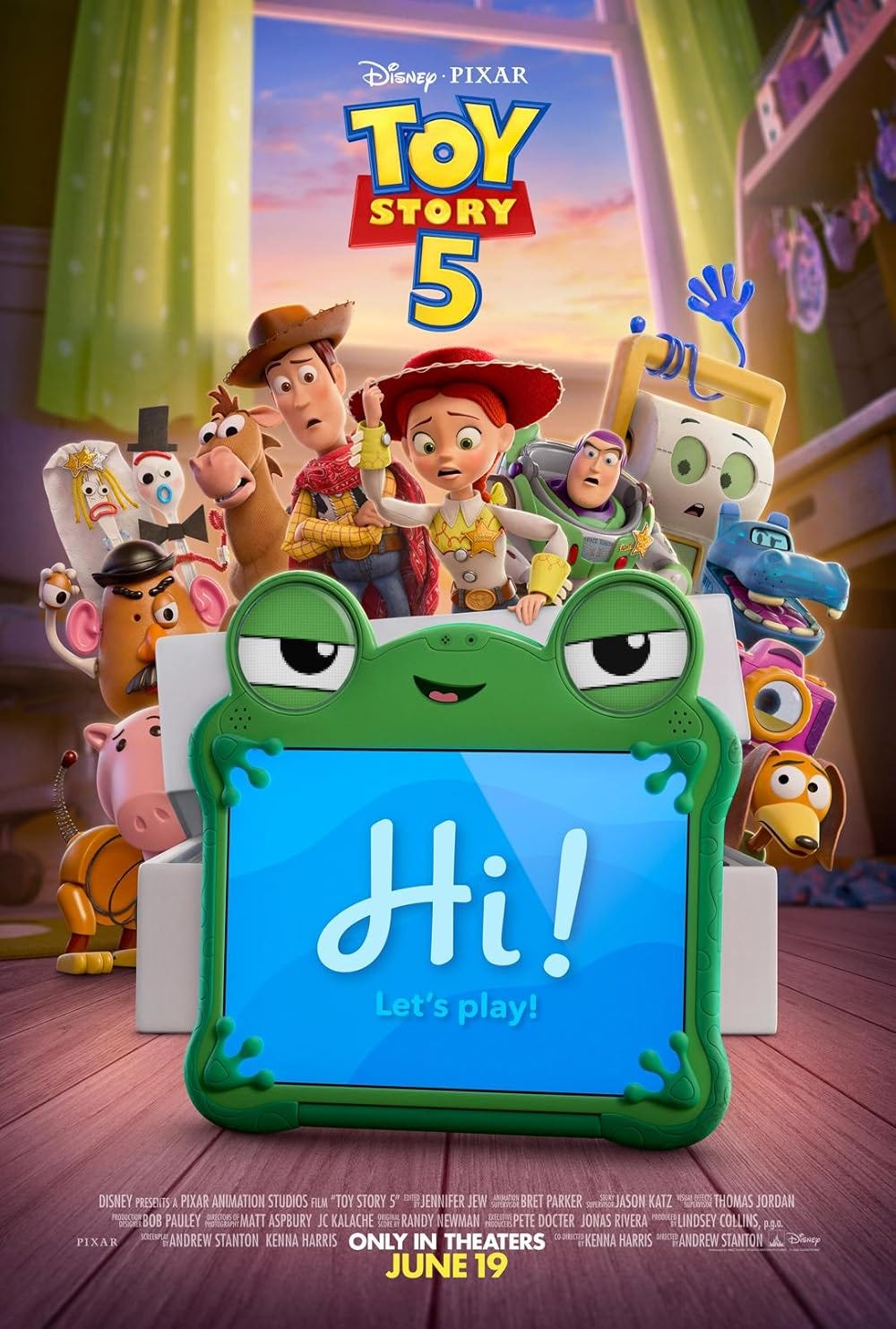
Forgive the brief switch to Hindu numerals; I’d rather not give the algorithm an unnecessary reason to make this Zephyr difficult to find. Caveat Lector: spoilers follow for Toy Story 5.
The original Toy Story came out the year I was born (1995); its sequel, Toy Story 2, when I was four (1999). These movies were a hallmark of my just-barely-a-Millennial upbringing, and their emotional grip touches some young parts of my soul; Toy Story 3 was delayed by some production challenges and didn’t come out until I was fifteen (2010), and its sequel, Toy Story 4, didn’t release for nine more years, until I was twenty-four (2019). These latter two installments, then, met me about a decade apart, one in high school (when the existential terror the toys faced in the incinerator at a local garbage dump was clever, I thought) and the other just the year after marriage (I was in grad school, we lived in an apartment, we didn’t even have a dog yet). This film, Toy Story 5, is the first one to have come out when I’m on the other side of the human character list: I’m a parent with a toy-toting child of my own, whom we took to see the movie (and her grandmother even got her Jessie and Bullseye ragdolls to mark the occasion).
If, somehow, you haven’t seen Toy Story in the thirty years it’s been in the culture, the premise follows the idea that toys are really ensouled beings and they come to life when you’re not looking. Rewatching these movies with my daughter in preparation for the new one, it occurred to me that I didn’t really remember there being quite so much…horror?…in the concept: the toys are always dealing with anxiety about being lost, left behind, outgrown, or physically damaged and destroyed beyond repair, not to mention their status as copies or molds of archetypical originals to whom they have only a physical resemblance. Each of these movies involves some degree of the toys coming to terms with the strange character of their existence and usually going on some mission to rescue one another, often on the premise that it is in the best interest of their child. Toys are, for the most part, happiest when they’re being played with and loved by children, but are continually faced by the problem that as children age, they undergo the regrettable business of becoming adults and outgrowing toys.
Toy Story 5 takes up a further premise, though, which is that children and toys are facing a uniquely new danger: the advent not just of technological toys (which have been around at least since the advent of the battery powered car in the 1940s), but of computer and tablet screens that prey upon children’s brains and addict them to their use for endless hours. “It’s the end of the age of toys!” says a shark pirate in a row boat, stuck in the sand of a backyard playground that hasn’t been used in months if not years: the movie makes a point to show children in their single digits alit with the glow of their screens across every house and apartment the toys can see. The devices also, through the opportunity to play simple online multiplayer games and chat, insert themselves as communicative tech for children. The toys, now led by Jessie, seek to help Bonnie (their owner following their donation by Andy, the original child in the franchise) make new friends, an obstacle she faces in trying to invite the neighbor kids to play with her, and do not trust LilyPad, the tablet device that Bonnie’s parents, in a moment of desperation, purchase for her in the hopes that it will connect her to new friends.
Toy Story’s main problem here is the way that the powers of communication opened by the Internet, wielded by children in an atomizing, isolating box for personal use, harms more than helps. The friends that LilyPad—a very anxious screen with good but misguided intentions—attempts to make for Bonnie are mean-spirited and abusive. Of course they are, I thought as I watched—they’re children drugged with screens. And it made sense to me too why Bonnie struggled to find children to connect with: the only one playing with toys in a world full of unchecked screen time, she’s also probably the most creative and emotionally intelligent of her peers.
When I was young enough to watch Toy Story, I remember being told that watching movies, television, and playing video games would eventually rot my brain. It didn’t, but I think the fear that went into that kind of rhetoric was a simplistic calculus like this: books make you smart, and popular media makes you dumb. Books do make you smart, and popular media can blunt your brain; but in 2026, this chiding I would sometimes receive just seems silly, because I have lived through the cultural revolutions that will actually eat your brain, especially when you’re too young to know better. There have been some critiques of Jonathan Haidt’s The Anxious Generation, but it doesn’t take rocket science to realize that the essential argument that the advent of the smartphone, easily accessible social media, and now Large Language Models / AI is a recipe for brain soup for the young, particularly for those who are given undiluted access at the young age when they need to learn other skills, like reading, thinking, writing, and, yes—playing. Why did hours of my life given to watching and rewatching my favorited films of the 70s, 80s, and 90s from my youth, to watching cartoons and Nick at Nite, to playing Super Smash Bros. and eventually older fare like Halo not just eviscerate my brain?
Easy: I was also doing other stuff. I was mostly doing other stuff. I was outside all the time, I played sports, I played with friends, I played with toys, I built Legos, I read books, I listened to music—I did normal kid stuff. I’m not saying I didn’t have my own childhood struggles—everyone does, and I had my share—but that my mind and body were being fed on a healthy, balanced diet of stimuli in a world where I largely lacked instant gratification of nearly any impulse.
Part of how I know that’s true is that since the advent of the smartphone and my getting ahold of one—around the age of seventeen, for me—it’s been true that it’s been habit-forming in terms of how often I’m on it when I’m not prevented from being so or when I don’t take intentional action to keep it away from myself. But I took up the habit at an age where I’d already had a normal formation on so many other fronts and so where whatever damage it’s done to me over time has at least been done in a context where resilience and healing are possible; not so for those who grow up with such things in their lives.
Play is the heart of creativity. It’s the soul of any later endeavor that seeks to make art or knowledge or any kind of goodness or beauty possible. Metaphysically speaking, play—lila in Sanskrit—is what God does in creating the world and guiding it (and apparently complicating the problem of evil by making toys sentient, at least according to Toy Story). When we don’t learn how to do it, do it enough, or do it with enough people, we lose something essential to our formation. The question for tech is not whether tech can be compatible with a childhood that emphasizes play, autonomy, and well-being but what kind of tech can be compatible. When I was young things like LilyPad didn’t exist; the first iPad came out in 2010 (contemporaneous with Toy Story 3). But video games, including handheld video games, existed; other screens existed. Why did those things not have the effect of depreciating play? Simple: because they were not designed to. A lot of personal tech is designed to be hard to put down, hard to not want to use, distracting, and constantly engaging through more negative emotions, ranging from anxiety to rage to depression. For children, operating with much less in the way of trained cognitive resistance to this kind of thing, this tech is often dangerous. I’ve railed before about AI, but the zombies created by screens in Toy Story are their own kind of problem.
Is it possible for them to be reconciled? I mean, I’m at least somewhat a creature of the times: my daughter has a tablet, but she doesn’t use it other than when she’s riding in the car for an extensive period and needs a distraction I can’t readily provide. In Toy Story 5, the solution is not to destroy the technology or get rid of it but to subordinate its use to the needs of play and human connection, to intentionally make it a means of community rather than of isolation. Accepting the tech is just as much a way of conforming to reality as is accepting that children grow up: so do societies, so do species. But that doesn’t mean that the rate or manner in which they do so has to be so fast-paced: as Jessie repeatedly says, the tech encourages kids to grow up faster than they’re really ready to, and this is the big problem with it, the thing that needs to be used to structure the technology to mitigate its harms. This being a movie, less is done to explicitly say that that is hard for anyone to do on their own, much less kids; it’s meant as an optimistic tale about the kind of cohesion that can exist between toys and tablets, and so doesn’t address the elephant in the room that the cognitively corrosive effects of the tech are features, not bugs.
I’ll say, last, that it’s possible—maybe even a good idea—for this to be the last Toy Story movie. I liked it plenty; my daughter adored it; as a connection to an early life that is now thirty years in the past, and often lost in the underbrush of my consciousness and unavailable to me, these movies are a nice reminder that once, a long time ago and before it all, I was a kid, and underneath it all, I still am that kid. Toy Story popping up at these intervals is a nice way to track my own growth as a person. And I don’t deny that perhaps there are other credible, well-told stories to do with the concept.
But much as I never want anything to really end, though, it’s clear even in this film that we are approaching a sense of completeness here. The Tom Hanks / Tim Allen duo that originally made these movies has begun to wear out (the movie wisely centers other characters); the central premises of the franchise, by the film’s own admission, are simply not reflecting the childhoods of the intended viewers back to them the way they did when I was a child. I don’t necessarily want a Toy Story 6 where Woody has to figure out how to outsmart a chatbot and force Bonnie to do her homework, or where the toys are asked to acclimate to a Teslabot living in the home. What these movies really, ultimately have to say seems finished to me: childhood is essential; your toys and your play made you as much as anything else; more of your personal virtues and flaws come down to good or bad play than you may realize. And what Toy Story 5 says in particular is: don’t let the advent of higher tech make you forget these core facts of being human. Don’t be tricked into giving up your childhood.